Shakti - She Who Breathes the World Awake
Every painting is an evolution, starting with a blank canvas. Something new reveals itself with each layer, each mark, and each brushstroke. When I finally put down my brushes, the painting is finished. The meaning it carries is still unfolding. Often these is an initial meaning that jumps out immediately. Most of the time the painting carries its deeper meaning quietly for a long time before it fully reveals itself. So I revisit and sit with my paintings regularly to listen to its message for me.
This was my experience with Shakti, the primordial cosmic energy and the dynamic feminine force behind all creation, change, and existence in Hinduism. She is not simply a goddess among others, she is the living energy that invigorates existence itself. The pulse that gives rise to creation, transformation, and renewal.
When I sat with painting in stillness, and revisited her over several days, and weeks, I started to understand what she was showing me. Shakti is most often represented with her eyes wide open, yet in my painting they were closed. This puzzled me immensely. Why were her eyes closed?
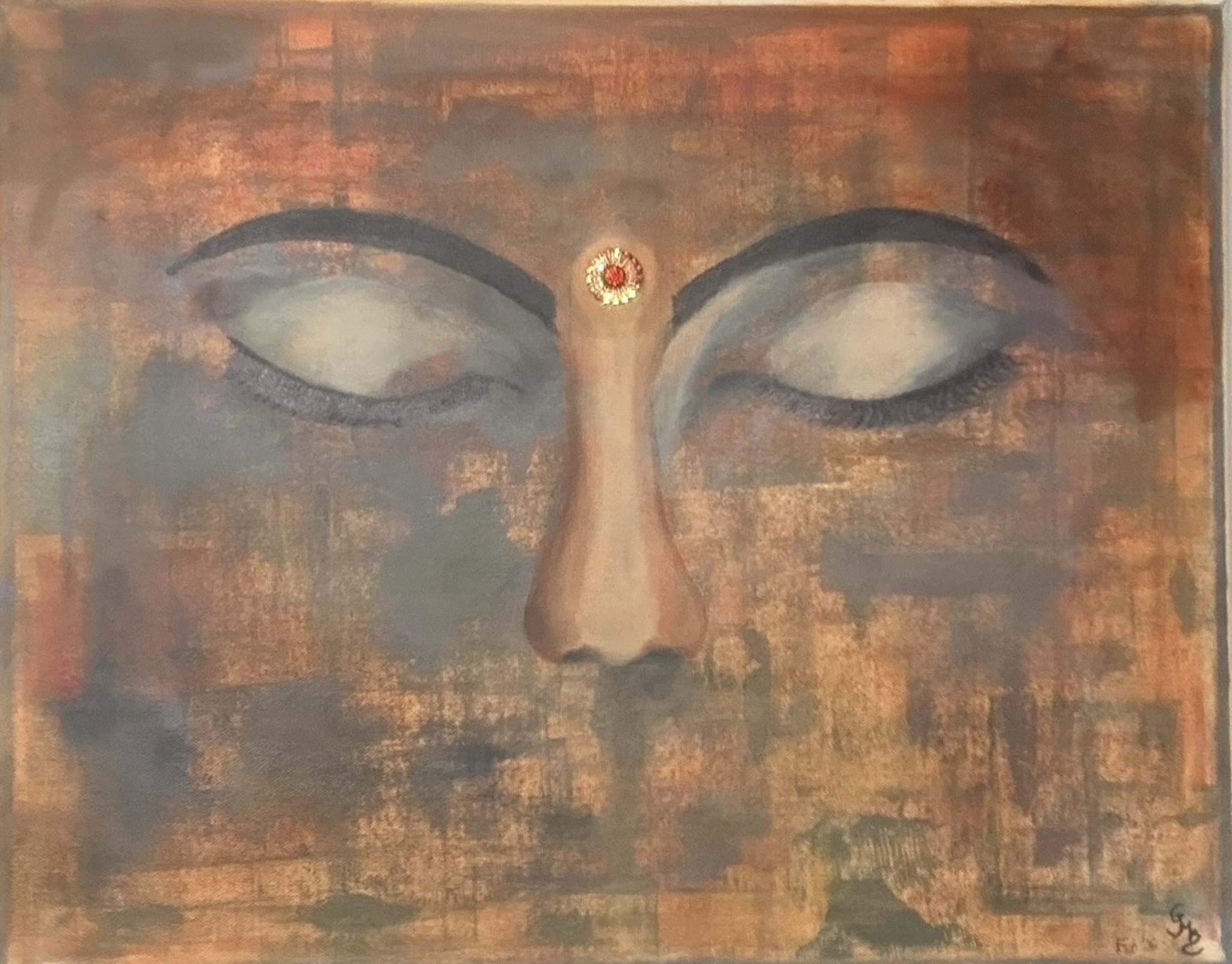
I often close my own eyes as I reflected deeply, as if my closed eyelids are a blank canvas on which I can paint what needs to be shown to the outside world. It is not shying away, not being absent, but an ignition of the wisdom to be revealed and shared. It is the moment before movement, before creation takes form, before the universe inhales. It is not rush in foolishly, but caringly. Her energy is grounded within her, and she is tapping into the her own groundedness.
The more I sat with her painting, the more I began to recognize that this painting is about power, but not in the conventional sense. It is about the power we embody within. The power that does not make us rush forward, as it moves from presence rather than pressure. The kind that arises when we stop trying to hold everything together and begin to listen more deeply we the wisdom already living within us. It is something we need to remember, to inhabit it.
There is something deeply feminine in this kind of presence. It does not require certainty, yet it carries profound authority. It does not dominate, yet it has the ability to transform what it touches. One of the places where this shift can be felt most clearly is in creative practices. When women sit down with paint, brush, and canvas, the usual structures of productivity and expectation begin to loosen. Something more instinctive starts to guide the process. Color moves where it wants to move. Shapes emerge without explanation. The body begins to respond before the mind has formed an interpretation. Over time, a different relationship to power takes place. Not the power of control, but the power of participation. The painting becomes less about producing something beautiful and more about allowing something true to appear. The painting becomes a mirror.
When I sit with Shakti now, I see and feel that reminder clearly. The image does not ask me to become stronger or more certain than I already am. Instead it is asking me to remember that my strength was never absent. To recognize that the energy has always lived within me, within my body. To trust that when we create space for it to surface, it will find its own way to surface into form.